Autumnals was a story concept I was playing around with for a while after I finished up the original version of People Mover. I imagined it as a satirical, dark comedy, sci-fi encyclopedic novel or novella, which aimed to play off of themes of militarism and xenophobia. Ultimately, I drafted some outlines for it, but never turned it into a finished product.
Around that same time, I had been rereading one of my all-time favourite bits of fiction: Flatland by Edwin A. Abbott. If you're unfamiliar with it, Flatland was written in 1884 as a satirical commentary on Victorian Era mores and morals. All of the characters in it are simple geometric shapes and the titular Flatland is a two-dimensional world that the protagonist, a square, lives in. Most of Flatland isn't a conventional narrative. Rather, a lot of it is simply these two-dimensional characters explaining the nature of their reality. Included is several descriptions of all these shapes' social customs, diagrams of what two-dimensional architecture looks like, and an explanation of Flatland's rigid social caste system - where status is almost wholly derived from the regularity and number of one's sides.
And I really liked the idea of doing something in that vein, but about a more modern social dynamic ripe for satire, and utilising a different metaphorical shorthand for gradations of an underclass or an out-group. What I eventually arrived at wanted to do was the concept of using space aliens in a science-fiction setting to parody historical (and contemporary) fear of outsiders by way of arbitrary colour differences. That basic premise has been done before; I can fondly recall seeing that one classic Sixties Star Trek episode about interminable conflict between the black-and-white and white-and-black aliens, for instance. But I think there could be a lot of original potential for heightening the satire by having characters always be able to forget their prior prejudices by way of repeatedly introducing more and more arbitrarily different outside groups.
My thinking was: historically, at the dawn of human civilsation, anyone's most immediate competition for resources - whether that be food, land, mates, etc. - were the other people physically closest to them. And that most likely means your family, brothers and cousins and so on. However, you could instead, band together with those people around you and work together as a family in order to secure those resources from people around all of you more effectively than fighting amongst yourselves. And broadly speaking, those that do this, survive and flourish much more than those who don't.
To that same end, your family unit and other nearby family units could even begin working together as a larger clan rather than merely continue to compete for resources between yourselves on this larger scale. Doing that at a big enough scale, most often along cultural and linguistic lines is how the first proto-nation states emerged, after all. These states tend to jostle among themselves - to put it in very simplified terms - until they either continue to merge, or get subsumed by a stronger group, or until all the parties involved pragmatically put down their differences in order to address a larger scope issue or threat to all of them.
Take for example, the Ancient Greeks. By the Classical Era, hundreds of small villages had organised themselves into regional city-states, the most powerful of those city-states formed leagues of allies and vassals around themselves and regularly went to war. But when need-be, could evidently rally together long enough to fight a common foe that posed an existential threat to all of them. In 500BC, if you were to ask someone to define the cultures of the Mediterranean - an Athenian is not a Spartan is not a Corinthian is not a Theban. But if they're working together to fight off a sudden Persian invasion - suddenly they've got a shared Greek-ness that must be defended.
It's a pattern that repeats all over human history, all over the world. And, similarly, that same basic thinking is seemingly behind a lot of modern prejudices. Not too long ago, an Englishman, an Irishman, an Italian, and a Pole would likely all conceive of themselves to be of entirely disparate cultural and racial stock. Nowadays, we'd simply consider them all White with a shared European heritage, and the contemporary racist White supremacist would be a lot less interested in agita between them, than with Black Africans or Brown Middle Easterners. Same has historically gone with religion; the Anglicans, the Lutherans, the Baptists, and the Catholics might all go to war with one another for thirty years over theological differences that look completely trivial to an outsider. But, tell them there's Muslims or Pagans on the next continent over, and all of a sudden you've got a unified pan-Christian league ready to go on crusade together at the drop of a hat.
I wanted Autumnals to take this basic premise and run with it. The way I plotted it out, prospectively: it's a sci-fi setting in the somewhat near-ish future, and Mankind has just made first contact with an interplanetary species. We had discovered, on Mars, a civilisation of upright-walking, tool-using, intelligent bipeds very similar to Humans. Except, whereas us Earth Humans are all various autumnal shades of beige and brown, due to the wildly different chemical composition of the Martian landscape, the inhabitants of Mars are bright colours like lime-green, hot pink and cyan.
Humanity and the Martians each benefit from several years of peaceful communication, trade, and intellectual exchange - but the atmosphere of the interplanetary peace eventually, and inevitably, sours. And perhaps even without any single major inciting incident, the heads of national governments of Earth begin to openly call for an end to the peace with Mars. Total war openly breaks out between a now-united Earth force and the Martians.
All of Mankind - forgoing our many internal ethnic, religious, and cultural divides is finally galvanised together by our mounting hatred of the Martian aliens and a lasting peace among the peoples of Earth is finally reached on the eve of our first inter-planetary military engagement. My notes from the time I was working on this recorded an idea that, at this point in the story, new racial slurs like "neons" and "glowies" used to describe the inhabitants of Mars emerge. And inversely, they call us "autumnals" and mock our comparitively plain brown-beige spectrum of skin tones.
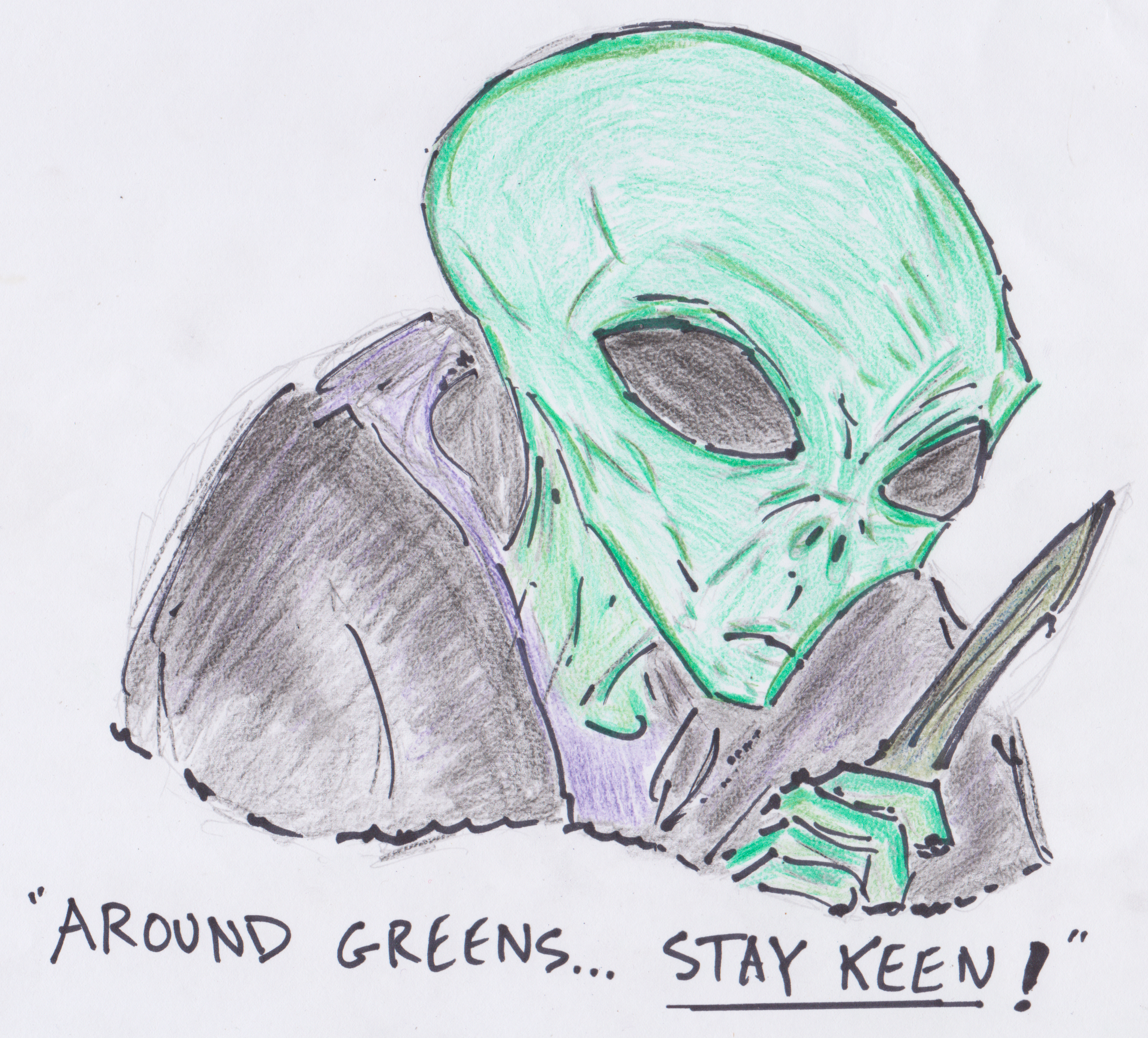
I even started brainstorming what sort of in-universe propaganda that interplanetary tension might produce as part of my holistic creative process.
The story then runs through a truncated history of the Earth-Mars conflict. During which time the war between the two planets has become a protracted, costly, and very bloody stalemate and the totalised military-industrial complex of Earth has increased our spacefaring capacity athousandfold. Decades into the war, space probes sent by the forces of Earth to the furthest corners of the solar system in search for resources to continue fueling the war with Mars eventually discover, and subsequently make contact with, a third sapient humanoid species living on Pluto.
The Plutonians and their society are very comparable to the inhabitants of Earth and Mars. Again, they're upright, intelligent, tool-using, bipeds of a similar degree of technological development. But, having evolved in the dark reaches of space so far from the light of the Sun, have stunted eyes and completely pallid, translucent, skin - like a cave salamander or a deep-sea fish. In short, both Earth and Mars to try to diplomatically draw the initially-ambivalent Pluto into the conflict on either respective parties' sides. But, relations between our side of the Solar System and theirs quickly sours, and a weary Earth and Mars manage to put aside our ongoing war to jointly attack the unfamiliar, clear-skinned, aliens.
This cycle of declaring hostilities, suffering needless losses, discovering a greater-scope other, and not learning anything from the experience repeats with a war between a Mars-Earth 'Opaque' military coalition and 'Translucent' Pluto. The timeline moves further along until this new war finally abates when the inhabitants of our solar system makes contact with an even more exotic, four-armed, quadruped, species from a planet in the orbit of a completely different star in our galaxy. And now, Earth, Mars, and Pluto all reconcile in order to attack this species.
This conflict only eventually subsides so that all four species can collectively, preemptively, attack the even-more-bizarre silicon-based lifeforms discovered to be inhabiting an entirely separate galaxy. The novella ends ambiguously, although pessimistically, tens of thousands of years - and trillions of lives - into this latest war between the carbon- and silicon-based entities of both galaxies when all of the corporeal races of this universe introduced thusfar are contacted by representatives of a species of pure energy who claim to be from a universe entirely beyond the boundaries of our own.
I really love the concept, and I've seriously contemplated going back to properly write this several times now. However, so far I haven't. Perhaps that's because I've been pursuing other projects and busy with other work instead. Or because after I finished writing People Mover, I decided I had no interest in shopping manuscripts around to publishers, so long-form fiction became less of a priority for me. Or just because I never had much of anything particular in mind for the page-to-page Autumnals narrative outside of the major plot beats.
I still might go back to Autumnals, or something like it, at some point in the future. Maybe in a totally different format or medium than how I originally imagined doing it. I've long felt that a concept like this one - which invokes for effect so many specific, disparate, character designs - might do well in a more visual medium, like a comic book or similar. Maybe that's something I'll work towards developing further down the line. Maybe I'll end up finishing it in collaboration with someone. Maybe I'll feel ready to write it up properly years from now - it's impossible to know what precisely the future holds. For the time being, it's just an idea I'm holding onto.
last major update: April 2026