I think it's really interesting and instructive to sometimes focus on the narrative mechanics of a story, rather than just the plot itself, to understand why it works or what sort of message its trying to convey. What I mean by that is, instead of looking at what story is being told, look at the 'shape' of how it's being told. Are you watching or reading a conventional orientation-complication-resolution story? Or a long epic narrative with multiple ups-and-downs, or a moral tale where the protagonist gradually overcomes some initial personal failing to succeed, or even something a bit postmodernist without any clear winners and losers?
There's hypothetically an infinite amount of these different forms any sort of story can take - although of course there's a handful of now-codified patterns we could readily use to describe most stories ever told. And, those occasional postmodernist slice-of-life pieces aside, there's almost always some form of conflict in any story. What I often love to examine in detail is how specific series, or franchises, or even different successive adaptations of a prior work will deliver that conflict through their narrative mechanics in a way that is most effective for the plot they're telling. Understanding that sort of thing can be very revealing of the author's intentions, and might allow you a bit of extra insight into the thematic meaning of a work. Also, knowing what sorts of narrative structures work best to tell different types of plots is a storytelling tradecraft fundamental if you're interested in writing yourself.
I think that if you're trying to tell a story which conveys a particular moral or tone, understanding this use of narrative dynamic is essential. How and when an author delivers their plot's complication or introduces conflict will often be a major deciding factor in whether or not a text retains the interest and intrigue of its audience. And, whether or not a story ends for its protagonist(s) on a victorious high note or a pessimistic low point - or anywhere in between - will practically define how we think of the whole of that story when we look back at it.
I wrote another piece here on my website touching on this concept using H. G. Wells' The War of the Worlds as an example. Specifically noting there how any adaptation of it, regardless of medium or precise setting, is strongest at conveying the original story's tone and gravitas so long as it also follows the novel's thematic arc mechanically. That is, in any The War of the Worlds-derived plot, the appearance of the aliens and the threat they pose should be treated as appropriately shocking and terrifying, and the somewhat
If a sequel to, or an adaptation of, a prior text fails to convey its central conflict impactfully enough, or doesn't appropriately establish the stakes and obstacles of its heroes' journey, or gives one character a contrived happy ending where previously one wasn't necessary or even earned, it suffers immensely for it. An adaptation or a sequel can potentially alter or subvert the material of its predecessor very effectively, but to do so poorly is the quickest way to undermine the entire thematic conceit of the story - and in today's consumer-driven media ecosystem, also potentially squander the reputation and goodwill attached to some of the most revered franchises on the market.
Here, I wanted to outline how I think one particular franchise has suffered significantly in exactly this way. That is, I want to discuss the gradual loss of tone and theme through sixty years of The Planet of The Apes sequels and reboots. Just to lend a bit of background to my thoughts here, I'm a pretty big fan of the Planet of the Apes series as a whole. I love the original Sixties films, I enjoy the newer films despite their flaws, and I really dig the original 1963 novel all the films are ultimately based off of. That being said, - enjoyable as they may be - the newest Apes movies have let the theme and message of the original story get away from them. I want to explain exactly why that is, and pitch at least one way I feel the franchise could have been taken in a different direction to correct this.
Here, I wanted to outline how I think one particular franchise has suffered significantly in exactly this way. That is, I want to discuss the gradual loss of tone and theme through sixty years of The Planet of The Apes sequels and reboots. Just to lend a bit of background to my thoughts here, I'm a pretty big fan of the Planet of the Apes series as a whole. I love the original Sixties films, I enjoy the newer films despite their flaws, and I really dig the original 1963 novel all the films are ultimately based off of. That being said, - enjoyable as they may be - the newest Apes movies have let the theme and message of the original story get away from them. I want to explain exactly why I think that, and pitch at least one way I feel the franchise could have been taken in a different direction to correct this.
Spoiler alert for the original Planet of The Apes book, and all the movies, from here on out by the way.
I would argue that the narrative arc of any Planet of The Apes story needs to be that a stand-in for humanity as a whole, be it an individual or society more broadly, comes into conflict with a militant outside force - the Apes - which initially appears primitive, but which is revealed to actually much more advanced than it seems. Then, crucially, any initial hope we'll see humanity easily win against this outside force is undercut by the very hubris of thinking it would be easy, and the scope of this cycle of hubris is revealed again to be much larger than we even initially thought to begin with. The basic moral of the story is that hubris and arrogance can very quickly lay waste to even the grandest, most well-intentioned ambitions of one man or a whole civilization.
The most important thing to keep in mind when adapting a franchise - either from one medium to another for the first time, or doing a modern reboot - isn't so much necessarily making sure it's a perfect one-to-one retelling of the original story, so much as it is a matter of using the same basic premise and narrative mechanics to explore the same themes. The core plot premise of any Planet of The Apes property is simple: Man comes into conflict with intelligent Apes. The narrative mechanic they use to tell these stories is a little more complex: establish the basic setting, then, it's a pattern of repeatedly introducing new complications - new vectors of conflict, new antagonists - and any chance of drawing down the tension or resolving the conflict is repeatedly, consistently, subverted and frustrated.
It's one of the boldest approaches to storytelling in all of mainstream sci-fi - but virtually every 'classic' Planet of The Apes story takes a very pessimistic - almost completely nihilistic - attitude towards the allegorical setting these stories take place in. Conflict between Man and the Apes almost always ratchets inexorably and unceasingly towards greater and greater extremes. In lieu of offering anything close to a optimistic resolution, almost every story in the series used to end with some big "twist reveal" that only reinforced the morose tenor of the plot.
In the original novel, the way this plays out is that a Human explorer from Earth inadvertently finds his way to an alien planet where the people he meets are very primitive and very caveman-like, essentially. He quickly learns that these people live in fear of being rounded up and wiped out by a society of anthropomorphic gorillas and orangutans and chimps - that's the outside antagonistic force. And this man from Earth seeing just how advanced the Ape society is, is the first big shocking reveal.
In the book, the protagonist can't properly communicate with the Apes - they don't speak our language. But he's captured, shown around portions of the Ape civilization, and gradually learns of their history as best he can. The second big shocking reveal towards the end of the story is just how advanced Ape society is - their cities rival anything humanity has ever made, and the reader finds out that the Apes essentially took over the planet after their version of humans became complacent and lazy and let society gradually collapse. By the time the story we're reading has started, the Apes were already on the verge of completely eradicating the last holdouts of their planet's Human resistance. And there's evidently no real way to stop it.
If the novel has one through-line to keep in mind, it's that what is essentially just a stand-in for Mankind, if on another planet, had their - read: our - place at the top of the natural order usurped because the decadence of modernity sapped Humanity of its natural edge. And another species, the Apes, was there to take their place. These Apes are like us Humans in so very many ways. They're upright primates, and they've since learned how to use tools and build city-sized communities, but they're much more militaristic - and, if not primitive per se, at least very crude in their methods.
We, the readers, are meant to take away that if that could happen on a planet just like ours. The author would like us to believe it could happen here with how we're headed too. Of course, a real-life societal collapse wouldn't literally come in the form of an Ape uprising, but the militant monkeys are a stand-in stand in for whatever regressive or militaristic social backlash might follow a period of social decadence.
For what it's worth, the man who wrote the original Planet of the Apes novel, Pierre Boulle, had essentially on the periphery of the French Resistance during the Second World War, being a supporter of Charles de Gaulle. And his correspondence with peers and friends from the time reveal that Boulle thought that the Vichy Fascist occupation of France during the War was, suffice to say, very bad - and, crucially, the result of Europe resting on its laurels a bit too much in the Twenties and Thirties, getting decadent again, and letting a regressive militant force build up in the middle of polite society.
So, in a really roundabout way, the Apes in the original Planet of the Apes book are basically a Nazi metaphor. And the author was attempting to emphasise the need to not getting complacent and letting Nazis emerge. The 1968 film adaptation is far from that heavy-handed with its allegorical political symbolism, however. There are a few allusions here and there with how, in that movie, Ape society looks down on Humanity with an attitude akin to Nineteenth Century race science, but for the most part it's a lot more subtle with that sort of parallel.
On the whole, the '68 movie does a very admirable job in translating the themes of the novel and its narrative structure of ever-ratcheting-up conflict, even with a plot that strays from that of the book quite a bit.
In the movie, the main protagonist - the Charlton Heston character - is an astronaut from Earth, whose spacecraft ends up crashing on an unknown planet. Heston has spent two-thousand years in suspended animation since his mission began and he doesn't know where he is. After the crash, all he knows is that wherever he's come down is populated by primitive caveman-like people. And, similarly in the book, very shortly thereafter, Heston and a number of other people are captured by a group of technologically advanced Apes who can talk, and walk upright, and who use guns and ride on horseback.
How the subsequent events play out is a bit different between the book and the film - largely just because of the differences in what you can easily do in the two different formats. In the book, the Ape society the protagonist is taken back to is a grand futuristic city. In the movie, it's more of a large-ish settlement, - and it looks quite a bit more crude or rustic than what we'd think of a human town of that size ought to look like. That's almost certainly just a film-making conceit. It's easy to write a description of something fantastical and futuristic on paper, but when you really need to build sets and hire actors and extras to populate your city, a director might start to think about how to scale things back.
The other necessary change here, is that, in the book, the protagonist and the Apes can't communicate - they don't share a language. But that's not a problem because we, the reader, can always just be told what the Apes are thinking and doing without them actually needing to verbalise it to a human character. In the 1968 movie, the Apes speak English perfectly well. After all, you need to have the audience understand them, and if half this film's dialogue was just monkey noises it would be impossible to make sense of. However, the film still cleverly comes up with a way to have protagonist Charlton Heston be unable to speak with the Apes after his capture - as he's being apprehended by some gorilla soldiers, they shoot him in the throat.
The bulk of the A-plot transpires while Heston is in the custody of the Ape settlement. And he has to slowly adjust to the reality he finds himself in, as well as heal from his wounds. Eventually, after spending quite a bit of time as the Apes' prisoner, Heston attempts an escape, and in the process runs around one of the Apes' scientific research complexes and a history museum. The fact the film's protagonist can't communicate properly for most of his time among the Apes allows the movie to slow-roll the reveal of just how large this strange and hostile monkey society is.
This all builds into the next big reveal; Heston is re-captured, and as he's caught in a big net he finally manages to choke out a few choice words for the Ape police dragging him away. No doubt you'll have heard the line parodied or referenced elsewhere before, even if you haven't seen the film - "Take your stinking paws off me, you damn, dirty ape!"
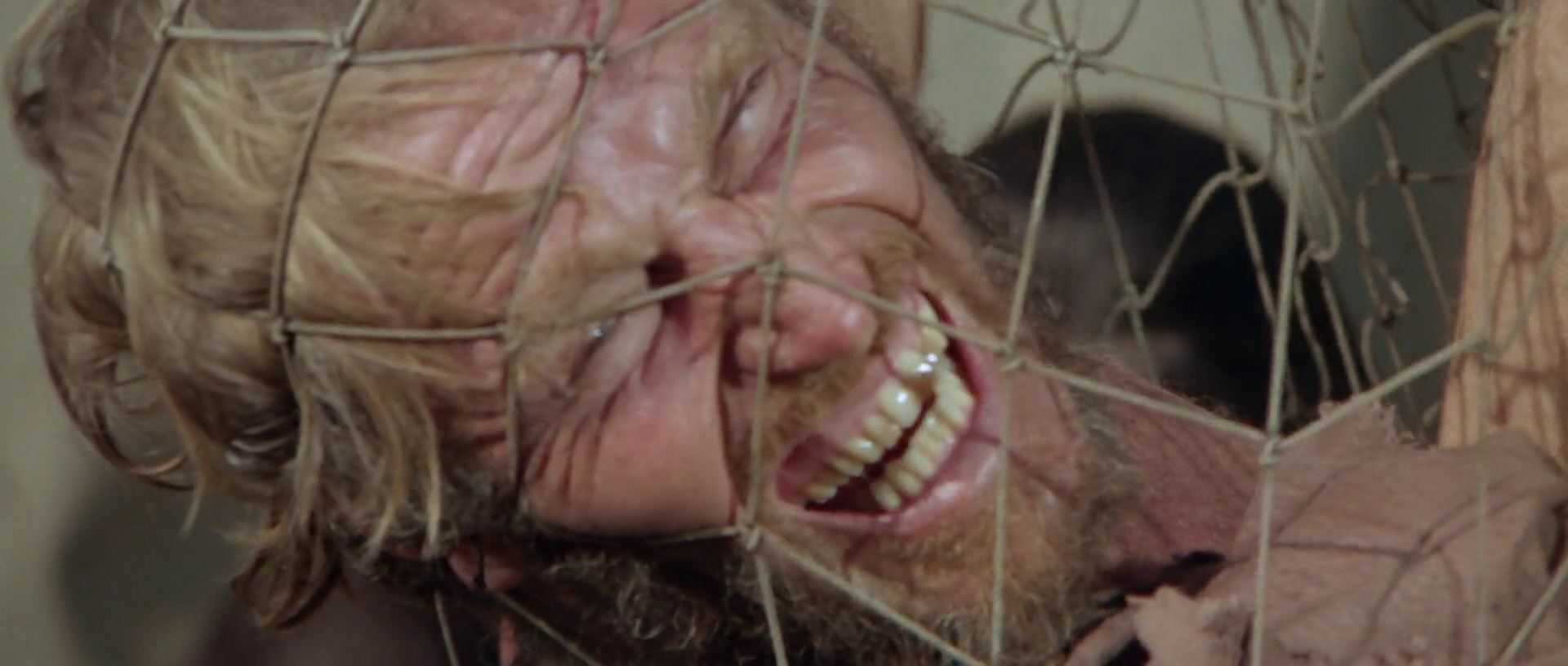
"Take your stinking paws off me, you damn, dirty ape!" - just one of several times in this movie Heston's line delivery will make a scene iconic.
For once, the Apes are caught off-guard, shocked by the reveal that one of their human captives can talk. It's a moment that isn't really in the book, and it works so effectively because, as a film, that's just a medium where dramatic action-scene acting and good line delivery can potentially sell that moment better than if it was just written down in a novel. And Heston does deliver it very well - there's a reason it's become such an iconic line, after all.
By this point in the movie, Heston's had his big moment trying to escape, having that escape attempt foiled, and seeing just so sophisticated the Ape society he's trapped in really is. A lot of the remainder of the film plays out the same as the last time he was captured. But now that he can passably communicate again, the protagonist tries to reason with his captors and explain that he's from another world and that he's not like the other humans they know, and that he ought to be freed - but they just don't listen to him.
Heston tries to make the case that humans like him are really an intelligent species and tries to prove it using what he, as an astronaut, knows. Long story short, by the end of the film, even if a lot of the Apes in a position of power over him know he's right, they're still rather just ignore him because it's easier for them to just ignore this inconvenient truth. Ultimately, in the movie's closing few scenes Heston makes another escape attempt riding off along the coast on horseback with a primitive human girl he meets along the way - and the Apes, more or less, decide he's not worth the trouble of going after and just let him go.
In the film's epilogue, Heston and the girl eventually stumble upon the ruins of the Statue of Liberty. It's another twist that wasn't in the book, but it serves to drive home the point that this planet isn't just like Earth, it is Earth. The astronaut's abortive mission hasn't delivered him to another world, it's just dumped him back on the ground two millennia into the future. The scene has become iconic, again in large part, because of just how well Heston acts it out - delivering an angry, teary-eyed, breakdown as he realises the implications. It works so effectively as a reveal unique to the movie, because it retains the thematic device of the last-minute complicating twist from the book, while specifically being a great way to convey that information in a audio-visual medium like film.
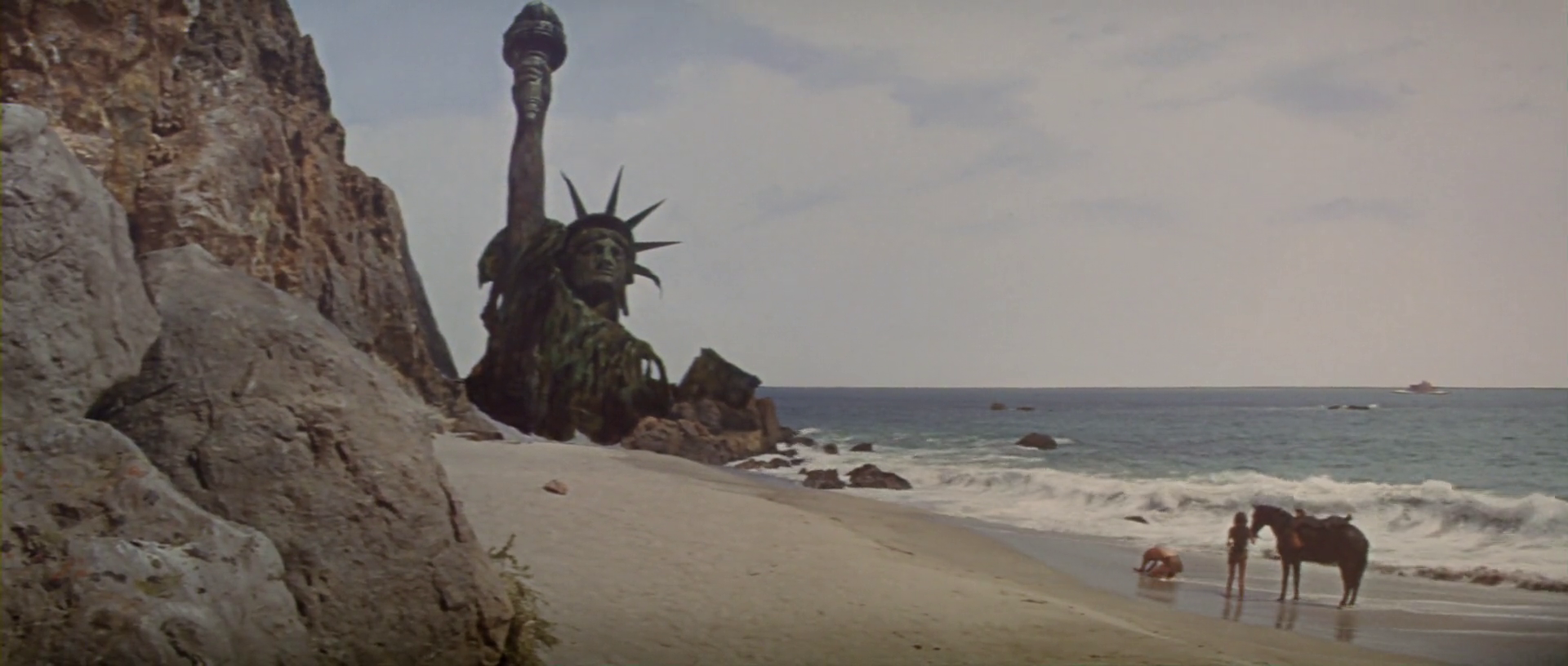
Heston wails in front of the fallen Statue of Liberty with the realisation he's been on Earth the whole time. Not just a legendary scene in-and-of-itself, but one that established the whole Planet of the Apes franchise's penchant for shocking last-second twists.
This final reveal really solidifies and encapsulates the film's central theme: the decay and de-evolution of human society. But the thematic strength of the film's whole second half isn't created by merely having all these twist reveals. Rather, it's created by having the Charlton Heston character go through a complete narrative arc of discovering this Ape society reality, repeatedly attempted to fight back against it by escaping or proving his captors wrong, and ultimately, coming to grips with the fact it's a futile effort. The "twists" are a result of the narrative mechanics of the story, - the constant elevating of the conflict of the story - they're not just ephemeral speedbumps on the way to a conventional ending.
Furthermore, note that the closest thing the first Planet of the Apes film has to an individuated antagonist character is the head Ape bureaucrat and scientist Dr. Zaius - the intelligent orangutan who most strenuously opposes the notion that Heston himself is anything more than a beast or that Humanity was ever an advanced species. The crucial thing is, the antagonistic force Heston fights in the movie isn't Dr. Zaius himself, per se, but rather, the ideology he represents. Which specific Ape scientist might be condemning humanity in any given moment is completely incidental, what matters is why an Ape would do that. This movie understands - like, dare I say, any good Apes will - that this series doesn't need personal villains for a protagonist to fight against. It works better when any 'villainous' characters are foremost a representative of a more intangible antagonistic concept.
Back in the Sixties and Seventies, they ended up making five of these Planet of the Apes movies, and they all hold up pretty decently for period sci-fi. I don't intend to spend tens of thousands of words just breaking down these movies. However, I do think it's worth at least very briefly exploring how at least one of these Seventies sequels also managed to get the necessary theme and tone right before I finally get to what I wanted to explain today: how the modern reboot Planet of the Apes movies have, largely, failed to in my opinion.
The second of the original films was called Beneath the Planet of the Apes, and it starts right where and when the first one ended: with Charlton Heston on the beach having just found out he's really on Earth. After his little breakdown on the beach, he just keeps riding his horse further and further away with his lady friend, looking for any remaining free humans outside the boundaries of the Ape society.
There's a few other B-plots that go on in the background, but the core story of Beneath is that Heston does end up finding a secret, underground, community of humans who haven't been subjugated by the Apes. This group of humans lives in the subterranean ruins of the old Earth, and importantly, these humans have in their possession, a functioning, immensely powerful, nuclear warhead - ready to be launched at a moment's notice.
A lot of the interpersonal moral drama of the movies comes from Charlton Heston trying to warn the leader of the underground society about the consequences of trying to use the warhead against the Apes even under the most dire of circumstances. Still, the underground humans live in such an ever-present state of fear of ever being discovered and attacked by the Apes that they keep the warhead on standby at all times - and have even taken to literally worshiping it like a divine figure.
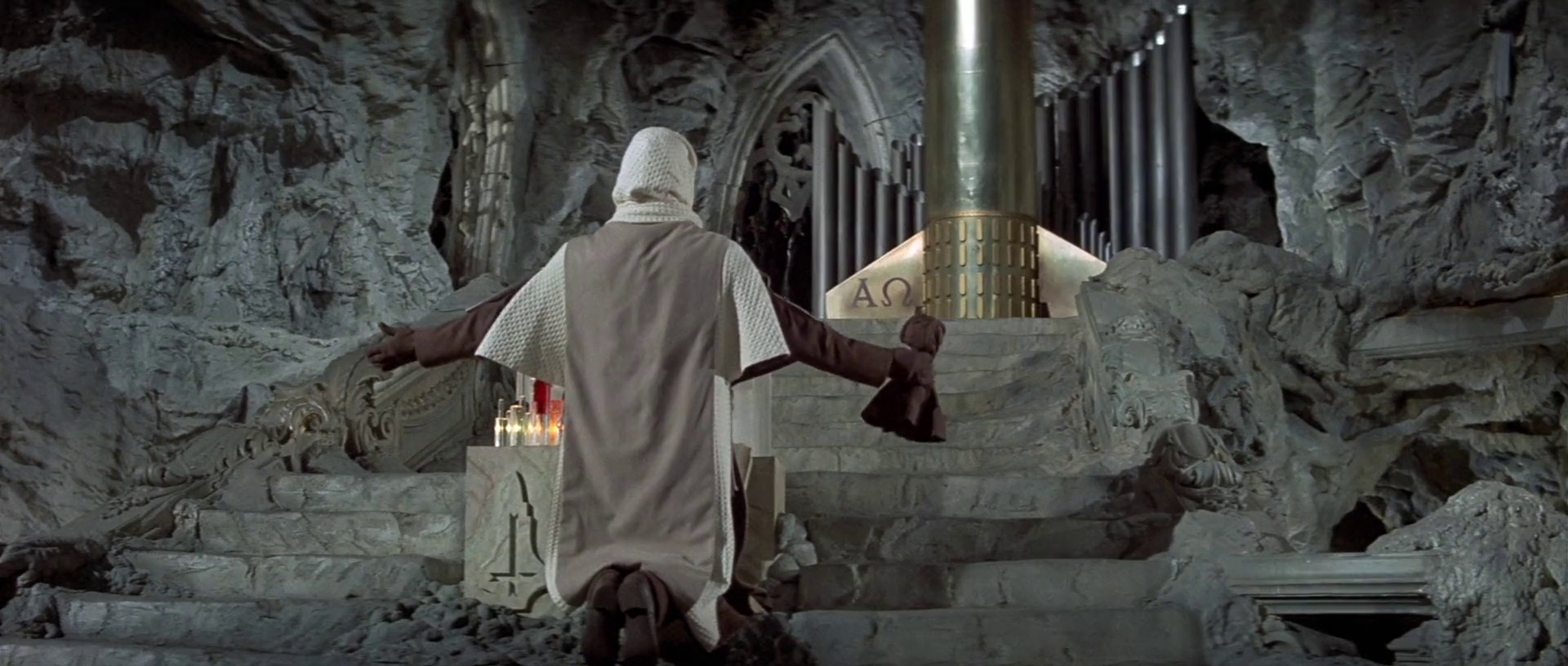
To have characters worship a launch-ready nuclear weapon isn't exactly the most subtle directorial choice in the world, but it does effectively raise the plot's stakes.
The initial premise of the film: that there is, in fact, a hidden society of humans still on the planet capable is a natural way of continuing the story beyond the first movie. And the reveal that they've got this massive nuke is a great and fitting way to raise the stakes by the end of the first act. Knowing that humanity has a weapon capable of very potentially wiping out the Apes, and themselves, gives the characters of this story a moral question to properly grapple with.
Heston and the leader of the underground Humans don't even directly fight with one another over what the best course of action is all that much. They don't need to, the moral dilemma the presence of the nuclear weapon poses speaks for itself - it's very effectively "show, don't tell". And Beneath the Planet of the Apes doesn't need to have a conventional 'bad guy' or a singular villain for the protagonist to battle. The main narrative arc of the film is all the Human characters delicately attempting to square the handful of different ways they know things could play out.
Should they perhaps launch the nuke now and try to retake the surface world? Or launch the nuke and hope it kills off all the Apes and they can live out the rest of their days in peace without the threat hanging over there head? Or should they just hope to stay undiscovered and undisturbed underground? That sort of conundrum is the baseline antagonistic tension of Beneath the Planet of the Apes, and the question's presence looms over the plot without the need of any villain character to plainly spell it out.
The big second act complication is that Charlton Heston realises that all these underground people, because they've been living in close proximity to a big nuclear weapon for several generations, are all suffering from all sorts of genetic abnormalities and radiation-borne illnesses and that sort of thing. This complicates the ethical dilemma everyone is in - it ratchets up the complication again. Because it means being underground with the warhead is itself a compounding problem; and even if their society remains undiscovered by the Apes, the Humans can't stay down there forever lest they die of radiation sickness.
It's the sort of symbolism you really shouldn't be surprised to see pop up in conscientious mid-Twentieth Century sci-fi. Beneath the Planet of the Apes is furthering the series' theme of societal degradation by playing off of contemporary nuclear weapon-related concerns. "The Bomb" is literally degrading the integrity of peoples' bodies, cell by cell - the social commentary is obvious.
By the end of the movie, one of those background B-plots established earlier on eventually lead to the Apes discovering the Humans' hidden sanctuary, and it looks like direct conflict is ultimately unavoidable. After a tense standoff, there's a big shootout scene towards the end between the Ape army and the last of the Human holdouts in their underground base. Charlton Heston tries his best to talk the leaders of both sides down - but it doesn't work, and he's fatally shot. He's slowly bleeding out from a big chest wound, but even with his dying words he still tries to stop the conflict. It still doesn't work. And, with the last of the humans surrounded and being advanced upon by hostile apes, he presses the big red button that sets off the nuke. Dramatic fade to bright white. Voice-over narration tells us that everyone - Man and Ape alike - was wiped off the face of the planet. End of movie.
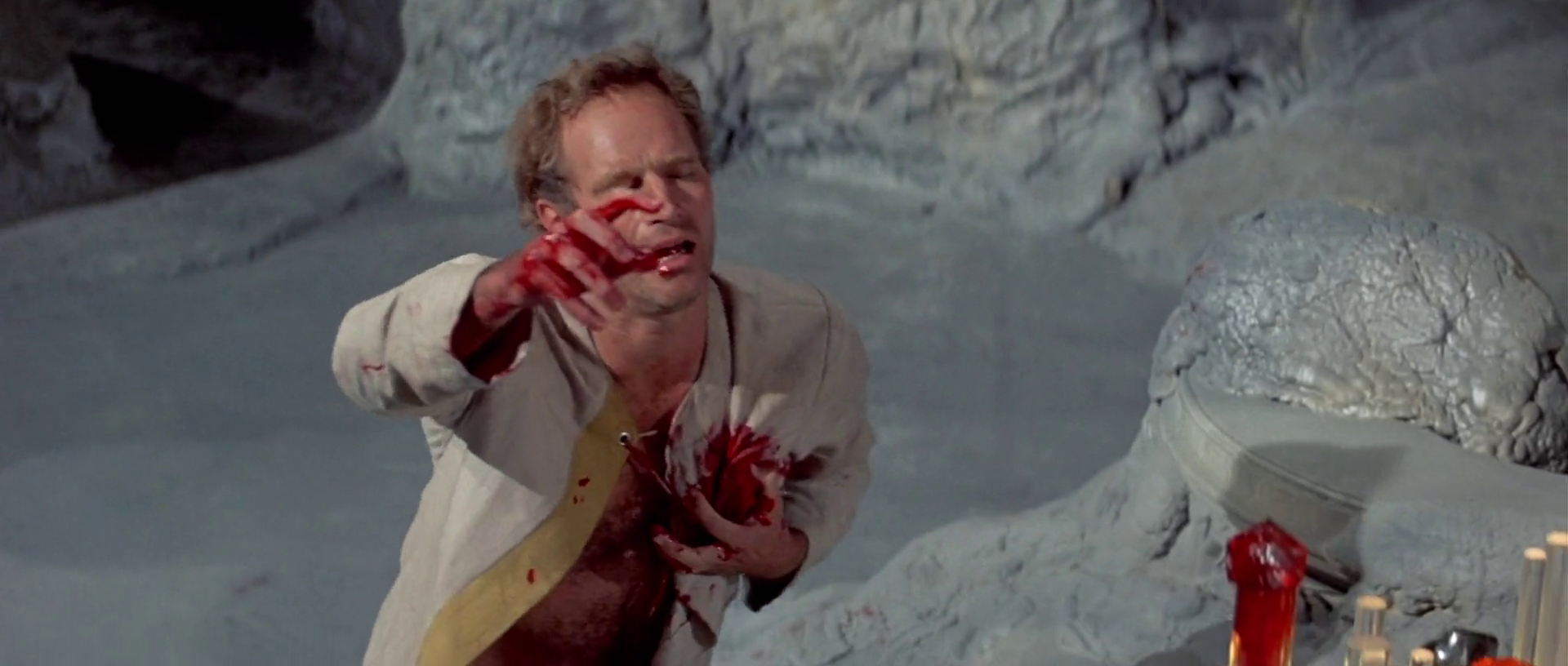
The final seconds of Beneath the Planet of the Apes. Shot and bleeding out, Charlton Heston finds just enough resolve within himself to slump his hand down onto the big red set-off-the-nuke-and-kill-all-life-on-the-planet button. You can decide for yourself if that was the right decision on his part.
This abrupt ending is the sort of nihilistic tone by way narrative mechanic I wanted to emphasise. All the old Planet of the Apes films are basically like this. They follow a pattern that works without being overly formulaic. Each movie understands how to use the premise of Apes having taken over the planet to explore a conflict between two imperfect world views, and the trademark move of the franchise is to escalate the threat this unresolved tension represents - up to, and including, within the final few minutes of the film itself.
Some of the later Seventies movies get a little bit schlocky, but they still work. Since Beneath the Planet of the Apes ends with the extinction of all life on the planet, Escape from-, Conquest of- and Battle for the Planet of the Apes had to be prequels, and ended up invoking a bit of time-travel here and there. But, still, all three latter movies still all basically work as both standalone stories and when viewed as a successive series of installments of a narrative being told about one world. Incidentally, even with the time-travel shenanigans in these installments, I think its a bold and apt choice that ultimately the prequels still don't stray away from the franchise's prior pessimistic outlook. They imply that anyone - Man, Ape, or otherwise - will still be fundamentally powerless to prevent or avert the inevitable nuclear apocalypse come the end of Beneath.
While I'm being thorough on the topic, I might as well also at least briefly digress to acknowledge the 2001 Tim Burton-directed Planet of the Apes one-off reboot. I don't want to spend too much time on it, because it's not one of the classic films or part of the new reboot films I specifically want to critique here. But, - disappointing as it may have been - I think it's still worth mentioning that I appreciate it's effort to explore the themes of the original films and the book while playing around with the premise in a different way.
It suffers a lot from some cheesy early-Two-Thousands performances and design choices, but it's a decent self-contained little project. Burton obviously is a competent and experienced director who had a distinct idea in mind for how he wanted to shoot his remake. Plus, I shamelessly enjoy a lot of the cheesy little nods to the original he includes, like recontextualising the "get your paws off me line" and giving that dialogue to an Ape. Also, the scene at the end where protagonist Mark Wahlberg comes face-to-face with an Ape version of the Lincoln Memorial is oft-derided as kinda dumb, but I must point out that scene was actually more or less lifted from the 1963 novel, funnily enough.
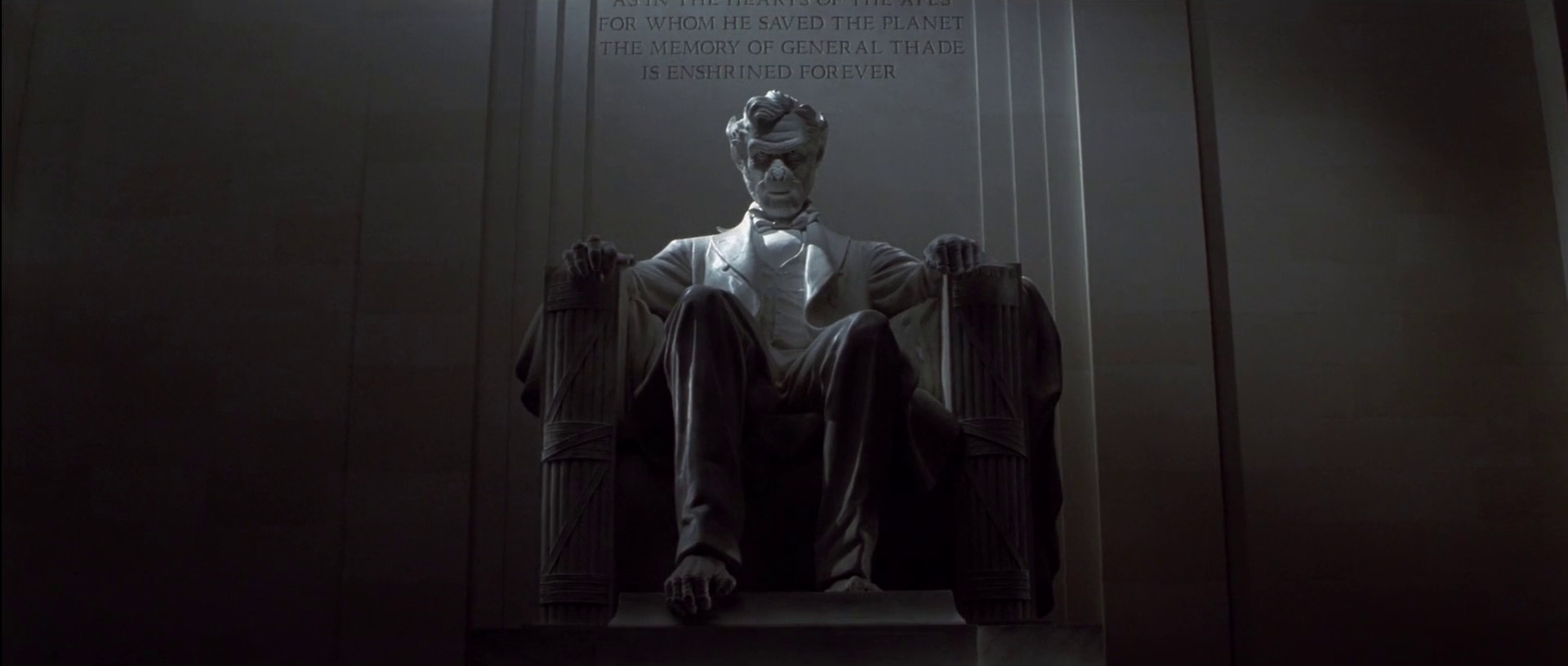
"Ape Lincoln". This is quite arguably the most-directly adapted scene from the original book to ever appear in any Planet of the Apes movie, believe it or not.
I bothered giving all those examples of how the Planet of the Apes franchise had previously embodied such a strong core thematic and narrative identity, so I could now start to get into why I would argue the most recent films in the franchise have unfortunately strayed significantly from those strengths.
I will preemptively say, the most recent Apes series - which began with 2011's Rise of the Planet of the Apes - are nice enough in their own right, in several respects, and do certainly a lot right in some ways. A lot of the cinematography and how individual scenes are framed and shot is really good. The actors' performances generally come across well, and in particular, the motion-capture performers and the CGI technicians or whoever who animated the photo-realistic monkeys all did a fantastic job there. And, as I understand it, these reboot movies were all made on a relatively low budget for big blockbuster movies these days, and I suppose that's always to be commended.
But, as standalone stories, or when viewed as a continuation or successor to the classic Planet of the Apes movies - these reboot films' single biggest flaw is that there is never any ideological conflict, and very little of the escalating conflict dynamic the older movies captured. There may be individual good guys, and good apes, who fight individual bad guys and bad apes, but there is no narrative arc in which any two or more properly articulated viewpoints ever come into conflict or oppose one another in any meaningful way. Arguably worse, the reboot films consistently opt not to go for any big, bold, shocking reveals or revelatory twists. Not every single film needs, or would even necessarily benefit, from that sort of plot element being included of course - but it's the sort of move you really do want to see pulled out at least once for the franchise that practically invented the last-minute shock reveal and became iconic for doing them.
The first reboot film - Rise of the Planet of the Apes - is probably the strongest of the newest films. The basic plot involves the first of the intelligent Apes being 'created' in a genetic research facility as the result of a man-made virus. The monkeys aren't treated all that well, and eventually they all breakout - setting up the eventual downfall of human society we'll see in its two sequels. I don't think there's anything inherently wrong with trying to take the franchise is a more overtly "realistic" 'hard' sci-fi direction - but the problem is that the film never really substantively ties its plot into any social critique.
There are definitely unlikable individual characters, and we're meant to sympathize with the captive research Apes. But there is no 'good worldview' and 'bad worldview' we're supposed to take any sort of message out of seeing come into conflict. The core value of the Planet of the Apes series hitherto was always the changing of society for the worse, and the militant backlash to that change which invariably leads to even more terrible outcomes.
You don't even need to be overly cynical to make a story like that, either - all the classic films' protagonists were those who essentially tried their best to keep things stable and as peaceful as possible. And even if they didn't often succeed in doing that - they were still shown to be in the right to try. In Rise, the monkey apocalypse happens essentially just because this is a franchise that needs to have a monkey apocalypse happen.
For all its faults, again, it is an interesting take on the premise of how the Apes become intelligent - and taken as the first in a planned trilogy of films (or, perhaps even more down the line) that could have then explored the classic themes of the series, it would have been a good way to establish everything we'd need to know. Unfortunately, the next couple new Apes movies that followed didn't really live up to that potential in the end either.
In any case, the second reboot film - 2014's Dawn of the Planet of the Apes - jumps the plot ahead ten years and shows us how clustered communities of intelligent Apes have begun to form, while the man-made illness that caused them to become intelligent has also drastically reduced the human population. The film sets up that there's a pocket of human survivors adjacent to the main Ape camp. And had the screenplay gone in a different - read: better - direction, the plot could have focused on that as a source of tension.
Unfortunately, what we ended up getting was that this whole potential storyline basically just peters out, while the movie focuses more on interpersonal quibbling between forgettable, unsympathetic, uninteresting, Human characters who are contrived to argue with one another and needlessly jeopardize the fragile state of peace between the Human and the Apes for no well-written reason. The climax of the film ends up becoming a CGI slap-fight between the original leader of the Apes, Caesar, and a bonobo named Koba who wants to usurp leadership and attack the humans.
If the majority of the plot had just been Ceasar and Koba clashing with one another about the ethics and feasibility of attacking the human community - that could have been a great Planet of the Apes story. Unfortunately, two-thirds of the movie's runtime was given over to the human B-plots, presumably just to make things more palatable to audiences. Flashy action and characters who can actually talk will be more engaging for most moviegoers, I suppose. But it's still unfortunate that Koba or a character like him wasn't given a decent amount of time on-screen in service of even just giving a protagonist Ape like Caesar a clearly articulated set of antagonistic beliefs to push against.
There is no meaningful narrative arc here. There is no tension. No sense of inevitable looming conflict. No genuine moral dilemma weighing on the characters. No grand finale. Not every movie necessarily needs the biggest, boldest, storyline - but, realistically, if you hoping to re-do the classic Planet of the Apes films you do need more than just "here are some Apes - and eventually a computer-generated action scene might happen".
Dawn of the Planet of the Apes also unfortunately suffers from needing to set up its own sequel too, so we end up with all the potential conflict plot-lines from the Human-Ape adjacent societies situation left up in the air by the time the credits roll. And not in a way that feels tense, or that gets the audience invested in what will happen next, - but in a way that's frankly at risk of leaving the viewer feel like they've wasted two hours.
So, two movies into this reboot, there hasn't been much of a meaningful narrative, there hasn't really been all that much ideological conflict, and we haven't gotten any of the series' trademark big shock twist reveals yet either. Still, going into the third (and once-presumed final) of the reboot Apes movies - 2017's War for the Planet of the Apes - I still think the potential was there to stick the landing, so to speak.
The plot of War picks up a few years after the events of the prior film, and we get two major story developments. One: that there is a now a heavily armed Human militia going around systematically and proficiently attempting to exterminate all the intelligent Apes. And two: that the Apes themselves are now on the backfoot and looking to get away from this militia.
This is the closest we get to seeing two conflicting ideological positions competing during any of the reboot movies. And while the remaining Apes and the militia-aligned Humans don't directly interact all that much throughout the movie, the juxtaposition of showing what each side is doing from scene to scene does go a ways towards giving us that sort of ideological back-and-forth.
On the Ape side, Caesar and his efforts to safely relocate his community, while sympathetic and noble to an end, also represent the continuing transition from society as it once was, to a world more inherently hostile to Man. On the militia side, they've got their own leader - Woody Harrelson playing a gruff military colonel stereotype. Harrelson is a decent foil to the Ape's ambitions; he's ruthless and pragmatic and embodies the militant response to social upheaval.
Around the art of the movie's third act, Harrelson's colonel is in the same room as Caesar and lays his position right on the table. It's not at all subtle, but at least we do at least get a sense of his motivations - unlike, say, those of Koba in the previous film. Bloodthirsty as he frequently comes across, Harrelson does have a real, reasonable interest in exterminating the Apes and thereby, the disease they spread. This scene also reminds everyone watching about the whole degenerative man-made disease subplot established in the previous two films. Which is helpful, but, as I'll elaborate on below - I believe this is also an element of the story the films' creators failed to use to its fullest potential.
As the movie starts wrapping up, Caesar recognises the inevitability of open conflict between the Apes and the militia and begins to ready an attack. The colonel, Harrelson, realises that he's showing the symptoms of the Apes' disease and ends up taking his own life. And the finale ends up being a big gunfight in which, despite being vastly out-numbered and out-gunned, the Apes end up being able to use some explosives to cause a avalanche to wipe out all the militia troops.
I think it's a weak ending. Mainly because it largely throws away the interesting dynamic between the two competing moral stances on display in favour of essentially just giving the more sympathetically-framed Apes a quick and uncomplicated victory where they can ride off into the sunset free. The problem is that - for one thing - it means the last two movies were just a lateral move. The situation the Apes are in once the credits roll here might as well be where they were at the end of the first reboot film.
The finale ends up turning Harrelson's character - and by extension, everyone in his militia, - into just another generic villainous force opposite Caesar, rather than giving any of the Humans a more compelling morally grey antagonist role. Arguably worse still, they also neglected the trademark Planet of the Apes shock reveal. The whole avalanche-saves-the-day thing isn't so much a shocking twist as it is a deus ex machina, an easy way to just end the story.
I can't say that the ending of War for the Planet of the Apes doesn't seem like it fits in with the rest of the 2011-and-onwards reboot films. But that's because the same pitfalls this movie is let down by are the same ones that prior two films also ended up succumbing to. Which I think is a shame. I like the classic movies and the novel and the premise they're all based off of - it's just that, if we're getting modern remakes of them, it would have been nice to get stronger films. It would have been nice if this reboot was tonally and narratively more in line with the original films, rather than largely being something more akin to decent, but generic, monkey-themed action movies.
Enjoyable enough as they are, I think a lot of Apes fans - myself certainly included - were simply expecting something different from these new movies. Something a bit more conceptual, or interested in presenting an ideological or philosophical proposal to grapple with. For all the inherent absurdity that comes with the premise of being about a militant post-apocalyptic monkey society, Planet of the Apes is a remarkably dry, contemplative, Human story.
All that said, even as I was personally watching War for the Planet of the Apes for the first time, I still felt like this third reboot movie had the potential to deliver a story and pull off an ending befitting this franchise. Let's say, hypothetically, I was in the position of writing and directing the War for the Planet of the Apes. Even assuming I had to use the same cast of characters, the same setting, the same basic premise, and couldn't do anything unreasonable budget-wise - what would I, as someone who has a lot of opinions about these movies, have changed?
Keep the first third of the film roughly the same. Give us time to establish where the Apes are, why they're starting to come into open conflict with human militia, and make sure to give us that scene juxtaposition where we get to see the viewpoint of both Caesar and Harrelson's colonel. Move the face-to-face confrontation between Harrelson and Caesar closer to about the half-way mark of the movie's total runtime. From there, have the Human militia and the Apes fight a bit - this can be where we get the big action scenes that modern audiences apparently want. And by and large, have the militia win. Show Ape causalities, show Apes captured, show them breaking ranks and running away. You could even go so far as to have Caesar himself be caught or killed here.
Towards the final third of the film would be where, again, you use the idea that Harrelson ends up realising he's got the degenerative Ape disease - even if, you want to have had him and his militia have killed virtually all of the intelligent Apes by then. The movie already established that the symptoms of this disease in humans was muteness, diminished mental capacity, and aggression. So I would have had the movie end up with the entire human militia movement becoming a pack of primitive tribalistic people. You could even have that be the explanation as for why this otherwise disciplined military commander was acting so tersely and belligerently the whole movie.
The first time I ever saw these reboot films, - perhaps I was just been getting my own hopes up - but this is what I genuinely thought was being foreshadowed the first time the disease plot-point was brought up. I honestly wanted, and half-expected, to see that these militia guys literally end up becoming the Ape-People we know from the classic Sixties and Seventies films. I would have had the disease begin to gradually turn the remaining Humans into what we see inhabiting the Ape society in the 1968 movie.
I think it's a reveal that would have fit the franchise. And after all, it does make a lot of thematic sense, and it's not like it contradicts any of the 'established canon', for what it's worth. The Apes in the 1968 movie don't look like photorealistic monkeys, like Caesar and company do in the reboot movies. They look more like devolved people - they walk upright bipedally, and all speak English, and wear clothes, and carry guns.
Again, the message of the novel, as well as all the original films, isn't that a dominant society can be simply replaced outright by another. It's that a society can be itself transformed and damaged by reactionary militarism. Pierre Boulle knew that the Nazis weren't an external treat to Europe's social order, they didn't come from elsewhere; they were European, the threat they posed was internal and began within Europe's social order.
I think the reboot Apes movies would have been fantastic, if by the end they connected them to the classic movies - but in a way that shockingly subverted everything we were expecting about where the "Ape uprising" plot was leading. For instance, if the intelligent monkeys we've been following the story of since 2011 were in fact not the progenitors of the far-future Ape species of the original films - but more like a sort of dialectical stepping-stone on the way to Humanity itself becoming the hostile civilisation Charlton Heston encounters in the original Planet of The Apes. I simply think an ending like this - at least in tone, if not exact specifics - would have been much more satisfying to fans of the series hoping for a narrative more in-line with what we've come to expect from this franchise.
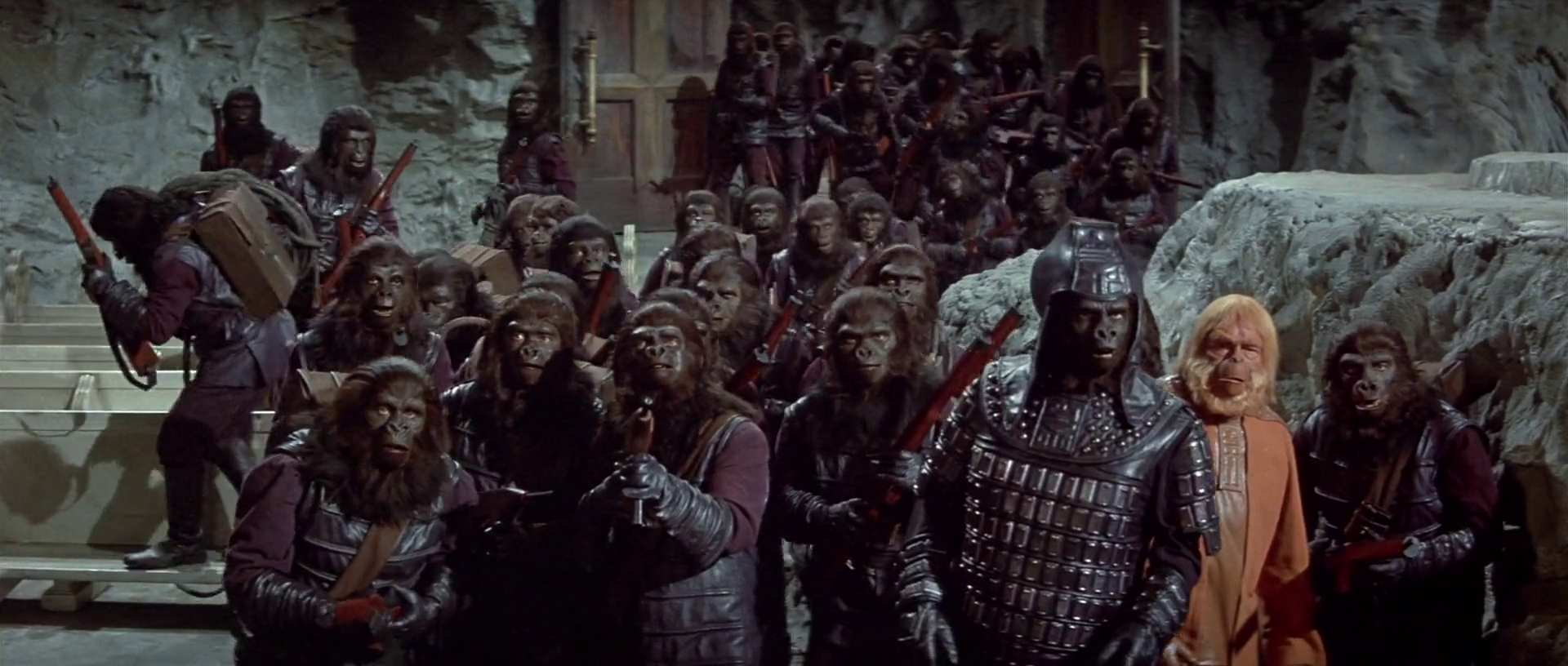
Do the original films' Apes not truly look more like devolved, militarised, Humans than merely upright chimpanzees?
NOTE: This piece was originally written years prior to the release of 2024's Kingdom of the Planet of the Apes - and obviously without any knowledge of that film's plot or direction - largely under the assumption that War for the Planet of the Apes would remain the final film in a rebooted Apes trilogy. If the series is to be continued in the relatively-near term, then I remain tentatively optimistic the filmmakers may still yet deliver a more satisfying, and 'traditional', Planet of the Apes movie eventually.
last major update: May 2026